All the cities here have one interesting feature - the closer to the center, the more dangerous. The least hazardous areas are respectable suburbs. |
1001  
|
Despite the abundance of cars, the quality of asphalt in the land is very good because it is laid using the correct technologies. |
1001
|
Local police never take bribes. This is simply because they value their work very much, especially against the backdrop of unemployment. |
1001
|
About 80% of all energy in the Republic is generated by burning coal. It is cheap, especially since this mineral has many reserves here, but such power plants pollute the atmosphere heavily. |
1001
|
South Africa ranks first in the world in terms of diamond production. |
1001
|
About 140 different types of fruit are exported from South Africa to other countries. |
1001
|
The Republic is the only country in Africa that has never had a coup d'etat. It has over 18,000 different plant species. |
1001
|
Only 15% of South Africa is suitable for agriculture, as the climate here is arid. However, this country is entirely self-sufficient in food. |
1001
|
Some of South Africa's gasoline is produced from coal. The country does not have its own oil deposits, and buying black gold is not cheap. But a lot of its coal lies close to the surface, so it is easy to extract. |
1001
|
More than 50% of all mohair in the world is produced in the Republic of South Africa. Mohair is a costly textile material obtained from the wool of Angora goats. In addition to cattle, ostriches are also popular in South Africa. There are quite a few ostrich farms here. |
1001
|
South Africa, with its diverse cultures and complex, various history, has become a key player in Africa's economy and politics. |
1001
|
The country, once a nuclear-armed nation, voluntarily renounced its weapons, highlighting its commitment to global peace and security. |
1001
|
In 1967, South Africa performed the first successful human heart transplant, marking a major milestone in medicine. |
1001
|
Some cities in South Africa, such as Cape Town and Johannesburg, are consistently included in the list of the most dangerous in the world. |
1001
|
According to several indicators, South Africa is one of the most dangerous countries in the world. Social surveys have shown that up to 40% of women here have been victims of violence at least once. |
1001
|
Local and rich cultural tapestry reflects its diverse inhabitants. The 'Afrikaners,' primarily descendants of German, Dutch, and French colonists, contribute significantly to the country's life. |
1001
|
Until 1994, South Africa was under the shadow of apartheid, a legalized system of racial discrimination and segregation. The legacy of this system is still evident today, with the descendants of white Afrikaners often living in separate, guarded settlements with high fences, contributing to the country's high racial tensions. |
1001
|
The Kingdom of Lesotho, a small country in southern Africa, is a complete enclave surrounded on all sides by South Africa. |
1001
|
The HIV prevalence rate here remains one of the highest in the world. According to some estimates, about 30% of the population in the Republic of South Africa is infected. |
1001
|
Vilakazi Street in Soweto, South Africa, is interesting because two Nobel Prize winners, Nelson Mandela and Desmond Tutu, lived on it. Now, Soweto is the most dangerous suburb of Johannesburg. |
1001
|
The local system grapples with a high unemployment rate, reaching 40%, and a significant portion of the employed population earning as little as $2 a day, highlighting the socio-economic challenges the country faces. |
1000
|
It is impossible to live here and not have a personal car. Public transport is very poorly developed, and it is simply dangerous, especially for those who do not look like native Africans. |
1000
|
The country has three capitals - Pretoria, Bloemfontein, and Cape Town. |
1000
|
The number of Caucasians here is higher than in any other African country—about 8%, although earlier this figure reached 40%. The outflow continues constantly; many Afrikaners move to Europe, Australia, and New Zealand. |
1000
|
Johannesburg is the most dangerous city in South Africa and one of the most dangerous cities in the world. |
1000
|
Durban (one of the cities of South Africa) is home to a great many descendants of people from India, which makes it the first in terms of the number of Indian population of cities outside of India itself. |
1000
|
Primitive people appeared precisely in South Africa, which is considered the cradle of humanity. Archaeologists have made the oldest finds here, which are about 2 million years old. |
1000
|
Locals who have something to lose never go for a walk in the streets—it's dangerous. You can only walk here in the guarded areas of some shopping centers. |
1000
|
About 10% of the population of the Republic of South Africa are illegal immigrants from other African countries, even poorer. They come here searching for work, but in 99% of cases, they join the ranks of slum dwellers. |
1000
|
This country is among the top 10 largest world wine producers. The climate is suitable, and good grape varieties were introduced hundreds of years ago. |
1000
|



 Share
Share

 PNG
PNG  PNG
PNG 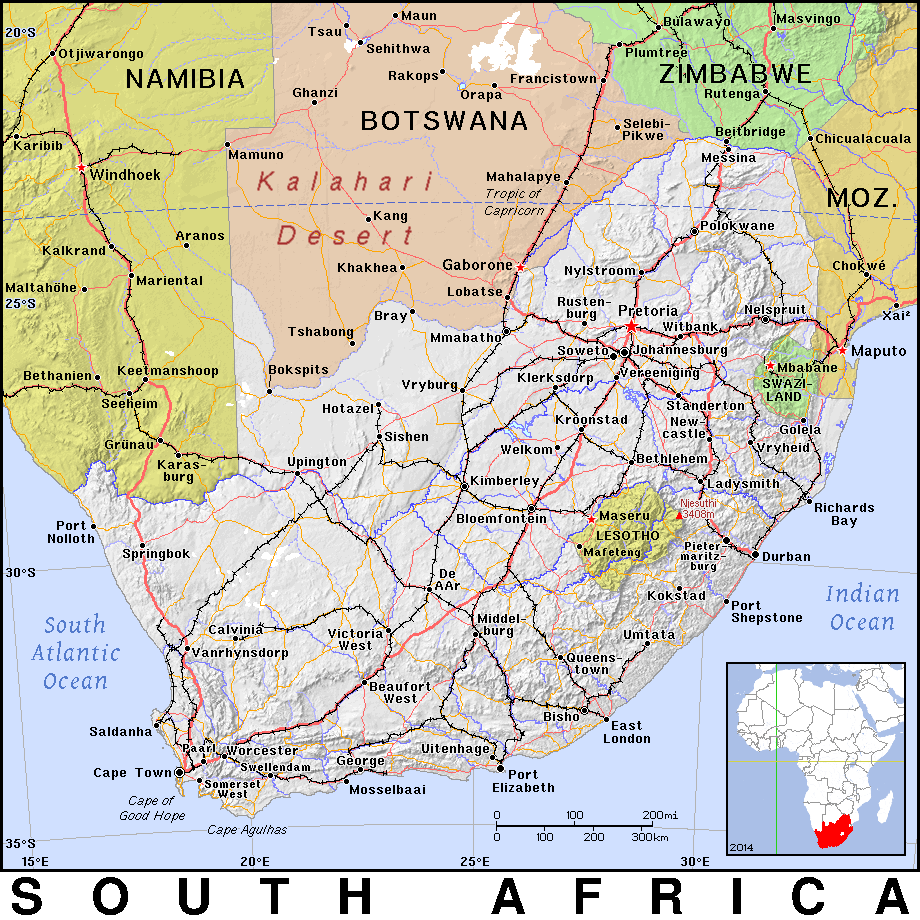 GIF
GIF  ZIP (TXT)