The percentage of vegetarians here is higher than in most countries in the world, except perhaps India. About 14% of the local population adheres to a vegetarian diet. |
1001  
|
The Republic of China includes not only the island of Taiwan, but also a group of smaller islands. Some of them also have a permanent population - for example, about 100 thousand people live on the Jinmen Islands. |
1001
|
Ancient people lived in Taiwan thousands of years ago, but they practically stopped developing. Thus, in the 17th century, the indigenous local population still lived in the Stone Age. |
1001
|
At the beginning of the 17th century, Holland and Spain began to compete for control of Taiwan. The former eventually won, but not for long - after two decades, China (more precisely, the Chinese Ming Empire) took the island back. |
1001
|
In the early 70s of the last century, the state system in Taiwan changed to a democratic one. Nowadays, this partially recognized state is one of the most developed in the world, the standard of living here is very high, and the GDP per capita is much higher than in China. |
1001
|
The climate on the island is tropical, it is always hot and humid. Snow and subzero temperatures are rare here only high in the mountains. |
1001
|
The capital of Taiwan is the city of Taipei, where about 3 million people live. It is located in the north of the island, and in general the population here is unevenly distributed - about 90% of all residents live on the west coast. |
1001
|
Until 1971, Taiwan was a member of the UN. However, by that time its influence had weakened, while the influence of the PRC, on the contrary, had increased, so the Taiwanese authorities simply excluded them from the UN, giving their place to a representative of the PRC. |
1001
|
Like mainland Chinese, Taiwanese usually call foreigners of European descent laowai. This word can mean both foreigner and ignoramus. |
1001
|
The state of Taiwan, called the Republic of China in full, is the successor state to the Kuomintang, the government of mainland China that was defeated in the Chinese Civil War. Having lost the battle for the country to the Communists, the remnants of the Kuomintang retreated to the island of Taiwan. |
1001
|
After its defeat in the civil war, Taiwan began to lose influence, and with it, diplomatic recognition. One by one, countries refused to recognize it as a legitimate state, recognizing not this country, but the PRC, modern China, as the “real” China. Currently, Taiwan’s legitimacy is recognized by only 15 UN member countries. Taiwan was a founding member of the UN. |
1001
|
Along the axis of the island stretch the Taiwan Mountains, a chain of which is 270 km long and up to 80 km wide. They include volcanoes, fortunately extinct - there are enough dangerous whims of nature here without them. |
1000
|
More than 90% of Taiwanese people go on to further education after completing compulsory school - colleges, universities, etc. It is not surprising that the percentage of the population with higher education is very high here, and the quality of Taiwanese education is considered one of the best in the world, especially in mathematics and various natural sciences. |
1000
|
At the end of the 16th century, the Japanese began to invade the island again and again, but without success, since by that time it had already been well developed by the Chinese, who were not going to give it up. |
1000
|
In 1550, the Portuguese named the island Formosa, which means Beautiful in Portuguese. But they did not even land on it, they simply sailed past. |
1000
|
The level of urbanization in Taiwan is also one of the highest in the world. There is practically no rural population here, almost all people live in cities. |
1000
|
The Republic of China provides itself with food for the most part independently. About 25% of the territory here is given over to agriculture, which is carried out very effectively. |
1000
|
Acid rain is a significant problem for the local ecology. Moreover, more than half of it during the monsoon season is brought by the wind from mainland China, where the environmental situation is generally quite sad. |
1000
|
The island of Taiwan is very rich in fauna, with about 20 thousand species of various living creatures living here. However, insectophobes will not be happy with this diversity, since about 17.6 thousand species of them are insects. |
1000
|
In the last century, striptease at funerals was quite popular here, this strange tradition originated among the local mafia, but later spread among the population. In the 80s of the 20th century, striptease at funerals was banned, but it is still found here and there. |
1000
|
Taiwan has embassies in dozens of countries, even those that do not recognize the country. But in such cases, due to the lack of official diplomatic relations, they are called “economic and cultural centers” rather than embassies. |
1000
|
Taiwan uses the old Chinese alphabet, while mainland China has long used simplified characters. As a result, Taiwanese can read simplified characters without problems, but mainland Chinese have difficulty reading the old alphabet. |
1000
|
Taiwan enjoys very limited support from other countries, because its support automatically leads to problems with the PRC. The latter's authorities follow the doctrine of one China, and an attempt to recognize the legitimacy of the Republic of China is perceived by them as aggression. |
1000
|
In ??order to gain diplomatic recognition from more countries, the Taiwanese authorities actively help various poor third world countries with money and technology, mainly in Africa and Oceania. They offer them loans or direct subsidies in exchange for diplomatic recognition. |
1000
|
It is the Republic of China that is the most developed and prosperous of all unrecognized and partially recognized states. It has a developed high-tech industry, and, in particular, a decent portion of all kinds of components for computers, smartphones and laptops are produced here. |
1000
|
A unique ecosystem has developed on the island of Taiwan. More than 3 thousand species of plants grow here, of which more than 50% are endemic, that is, they are not found anywhere else in the world. |
1000
|
Our planet has given this region more than enough natural disasters. Floods, earthquakes, typhoons – disasters of this kind happen here much more often than we would like. |
1000
|
It was in Taiwan that the first skyscraper on Earth with a huge pendulum inside was built, which in the event of tremors begins to swing and thereby dampens the swaying of the building. Similar skyscrapers were subsequently built in some other countries, and they are very effective, but they cost a lot of money. |
1000
|
The percentage of vegetarians here is higher than in most countries in the world, except perhaps India. About 14% of the local population adheres to a vegetarian diet. |
1000
|
The Taiwan Mountains stretch along the axis of the island, a chain of which is 270 km long and up to 80 km wide. They also include volcanoes, fortunately extinct – there are enough dangerous whims of nature here without them. |
1000
|



 Share
Share

 PNG
PNG  PNG
PNG 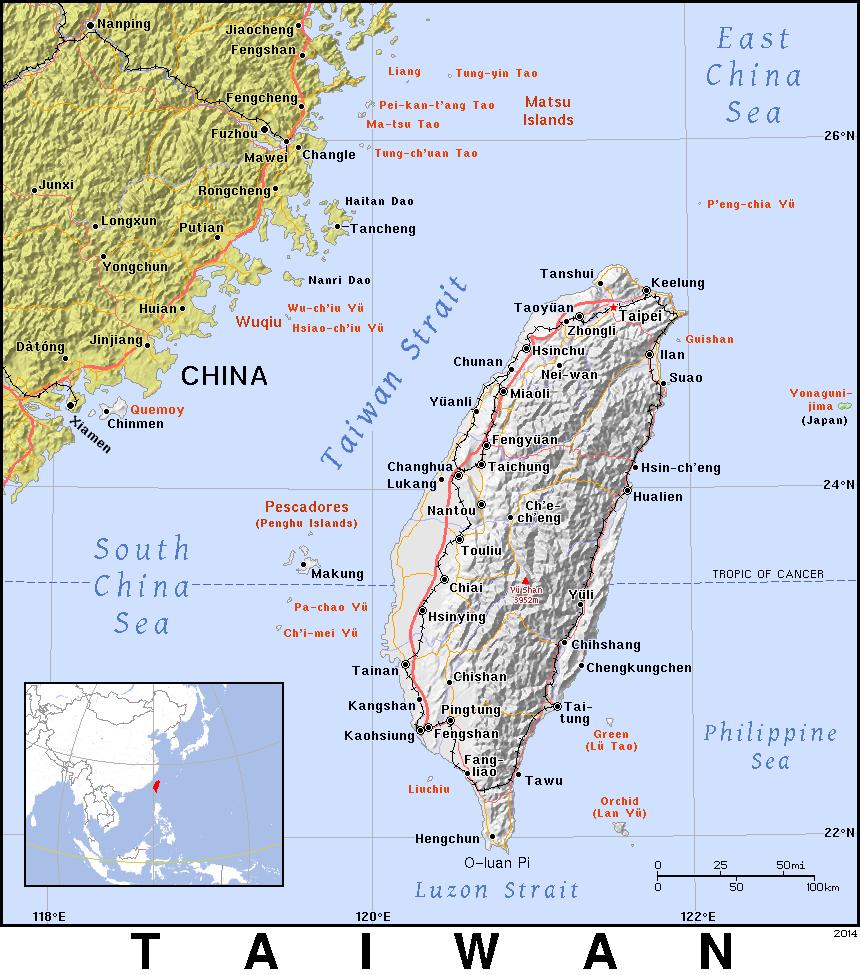 GIF
GIF  ZIP (TXT)