The country is a great place for castle visitors. It has a remarkable cultural landscape with hundreds of castles, ruins, and fortresses. It features more castles per capita than any other country. Notable examples include the well-preserved Bojnice Castle, a fairytale-like structure, and the impressive Spis Castle, one of the largest in Central Europe. These unique attractions are sure to intrigue and inspire any history buff or travel enthusiast. |
1001  
|
While Andy Warhol is synonymous with American pop art, few people know that his parents emigrated from a small village in northeastern Slovakia. The town of Miková, where Warhol's parents lived before moving to the United States, now stands proud. Medzilaborce is home to the Andy Warhol Museum of Modern Art, featuring original works and memorabilia. This unexpected destination is a fascinating spot for art lovers visiting Slovakia. |
1001
|
The village of Vlkolinec in the central part of the country is home to a beautifully preserved folk architecture reserve. This UNESCO World Heritage Site is a living example of a traditional Central European village. It features well-preserved wooden buildings, some dating back to the 15th century. Remarkably, Vlkolínec is almost entirely preserved in its original state and is one of the last intact settlements of this type in Slovakia. The village offers a unique glimpse into the traditional lifestyle of the region's historic inhabitants, including their distinctive wooden architecture and use of vibrant colors. |
1001
|
Slovakia is home to the Alpine Newt in the High Tatras Mountains, known for its vibrant blue and orange colors during mating season. This unique ecosystem, part of the Carpathian Mountains, supports diverse wildlife and showcases Slovakia's pristine habitats. |
1001
|
The small city of Kosice, the second largest in Slovakia, hosts the oldest marathon in Europe and the second oldest in the world after the Boston Marathon. The Košice Peace Marathon was first held in 1924 and has been held yearly, except during World War II. Not only does this event highlight the historical and cultural significance of Košice, but it also attracts thousands of runners and spectators worldwide, promoting the spirit of international friendship and peace. |
1001
|
Until 1945, you could get from Bratislava to Vienna by a simple tram, and even today, ordinary suburban trains run between them, making it easy and safe for tourists to explore both cities. |
1001
|
In this country in the 16th century, the infamous Countess Bathory lived, famous for her bloody murders. She is considered the most terrible European maniac among women; she was even included in the Guinness Book of Records as serial killer No. 1. They say that her restless spirit still roams the corridors of the ?akhtinsky castle. |
1001
|
Curious tourists can find the largest wooden altar in the world in the Church of St. Jacob. It is more than 18 meters high and more than 6 meters wide. |
1001
|
The Herlian Geyser located in Košice is Europe's only source of cold artesian water. It erupts approximately once every two days, or more precisely, every 32-36 hours. |
1001
|
A celestial body is named after Slovakia — asteroid 1807. |
1001
|
A peculiar local symbol is the Chuvac dog, which has been used to herd mountain flocks since ancient times. |
1001
|
The country is also famous worldwide for its hockey—all fans know its players and the Hockey Hall of Fame in Bratislava is a must-see on city tours. |
1001
|
Formerly part of Czechoslovakia, Slovakia peacefully gained independence in a 'velvet divorce,' a term used to describe the peaceful separation of Czechoslovakia into two independent states, the Czech Republic and Slovakia, in 1993. |
1001
|
On January 1, 1993, Czechoslovakia split into two independent states: the Czech Republic and Slovakia. Since then, Slovakia has developed its own political, economic, and cultural identity. |
1000
|
Beer is an integral part of local culture, and there is a strong tradition of drinking. Slovaks often meet in pubs and beer halls, and beer is commonly enjoyed at social events and celebrations. The country also has a growing craft beer scene featuring a variety of local breweries. This passion for beer highlights its significance in Slovakia's social life. |
1000
|
Did you see real bear? Slovakia's forests preserve biodiversity and serve as habitats for wildlife, including brown bears found in national parks and nature reserves. This coexistence of vast forests and diverse wildlife makes Slovakia a prime destination for nature lovers and ecotourists. |
1000
|
The land is home to many incredible caves with amazing geological formations. Notable among them are the Dobsinska Ice Cave, known for its ice formations, and the UNESCO-listed Domica Cave. These wild wonders attract visitors with intricate stalactites, stalagmites, and impressive underground chambers. |
1000
|
The Devil's Stone, or the Devil's Rock, is a great rock formation in the Cachtice region. This geological wonder stands out for its unusual shape and its folklore. According to local legend, the Devil threw the massive stone from the nearby Cachtice Castle. |
1000
|
The land has numerous bridges that work well for infrastructure, such as the SNP Bridge in Bratislava over the Danube and the Slovak National Uprising Bridge in Banska Bystrica. |
1000
|
The Tatra Mountains, located on the border of Slovakia and Poland, are one of the highest mountain ranges in the Carpathians. It is also home to Slovakia's highest peak, Gerlachovska Mountain, at 2,655 meters. |
1000
|
The country offers unique opportunities for health tourism and outdoor recreation. The country has become a popular destination for visiting spa resorts thanks to its mountain mineral springs. |
1000
|
Slovak cuisine is known for its delicious and nutritious dishes. One of the most popular national appetizers is bryndzový halušky - traditional buckwheat balls served with processed cheese and goulash. |
1000
|
Smoking in public places has been completely banned in Slovakia since 2018. This decision will help create a healthier and more environmentally friendly atmosphere in the country. |
1000
|
Slovakia is known for its ski resorts, which attract winter sports enthusiasts from all over the world. Žasná Nízke Tatry, Stráže Bittorfel, and Lomnica in the Tatras are just a few of the many opportunities for active recreation on the mountain slopes. |
1000
|
The oldest artifact discovered in today's Slovak Republic is the Moravian Venus figurine. This figurine, made of mammoth tusks and 7.6 cm high, was made about 22 thousand years BC. |
1000
|
It is the easternmost Gothic cathedral in Europe. The St. Elizabeth dome in Košice is Slovakia's largest church, where holy masses are still held. The building, whose towers are richly decorated, is one of Central Europe's masterpieces of medieval art. Among other things, this temple has been a national cultural monument since 1970. |
1000
|
History. The first people to live in Slovakia were the Celts, whose arrival dates back to the middle of the 2nd millennium BC. They were also called the Mysterious Nation. They operated throughout the territory until the Roman invasion. The first legions appeared in 6 AD. |
1000
|
The country is home to the oldest wooden church in Slovakia, St. Francis of Assisi. It was built at the turn of the 15th and 16th centuries. Situated in the village of Hervartov near Bardejov, it is one of the national cultural monuments and is also included in the UNESCO World Heritage List. |
1000
|
Slovakia or Slovenia? The embassies of both countries have encountered some truly bizarre situations. One and regular exchange of email addresses between these embassies is also common, so Slovenian citizens receive emails from the embassy of the Slovak Republic. |
1000
|
The village of Cicmany is known for its traditional wooden houses. You may not know that this village is the first protected area in the world that maintains folklore and historical traditions. |
1000
|



 Share
Share

 PNG
PNG  PNG
PNG 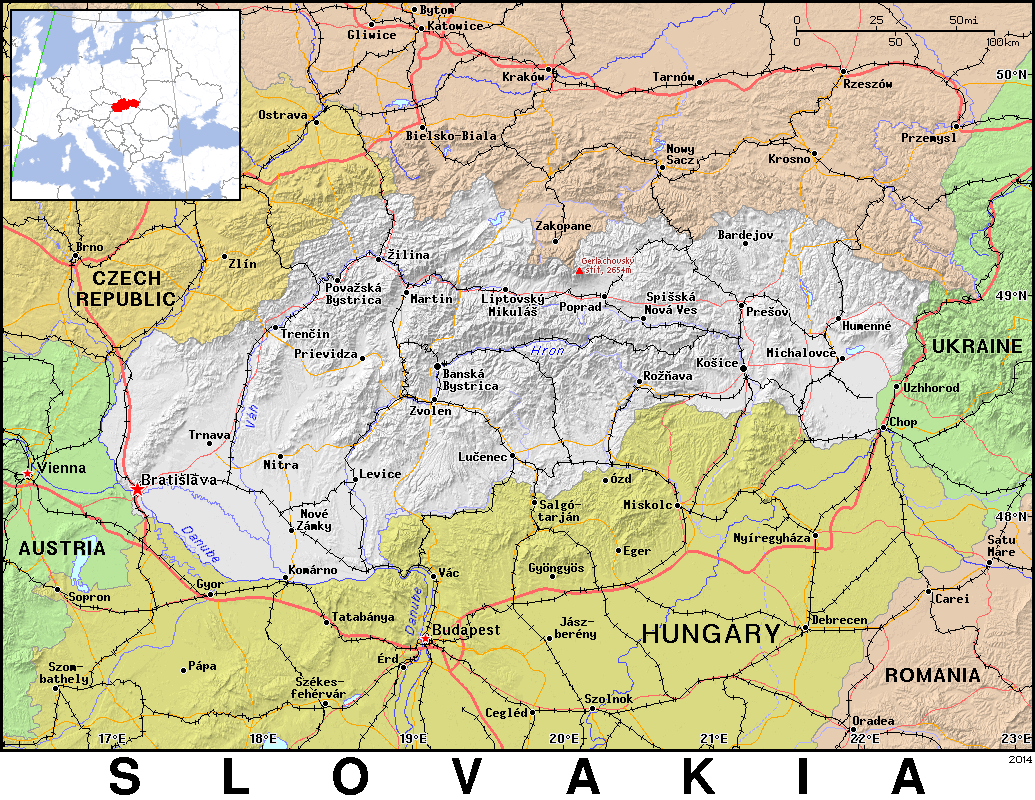 GIF
GIF  ZIP (TXT)