The population of Amsterdam doubles on King's Day. |
1001  
|
To celebrate the country's biggest holiday, 600,000 to 1,000,000 people come to the city every year, which is not bad for a town with a population of 821,000. It is customary to dress in orange on this day, and the average person spends 30 EUR on orange clothes and souvenirs for the holiday. |
1001
|
Marijuana and psychedelic mushrooms are illegal in the country as 'controlled substances.' Although there are licenses for the cultivation and sale of marijuana, transportation remains unregulated, causing issues for drivers, couriers, and coffee shops. |
1001
|
The colony of New Netherlands was founded by the Dutch West India Company in 1624 and covered all of modern New York, as well as parts of Long Island, New Jersey (thanks, damn) and Connecticut. And you didn't think that Harlem and Haarlem were a coincidence? In 1664, New Amsterdam came under the control of England. |
1001
|
The state is the largest exporter of flowers in the world, sometimes called the flower shop of the world. And absolutely not for nothing. The Dutch produce 4.3 billion tulip bulbs per year (that's 90% of world production!) and 80% of flower bulbs in general, and the flower industry makes a very significant contribution to the GDP of the Netherlands—a little more than 5%. |
1001
|
A third of the country's territory is below sea level. The Netherlands can be translated as Lands, and the country more than deserves this name. Almost a third of the territory is below sea level, and another 50% is less than 1 meter above sea level. |
1001
|
There is not a single mountain in the country, and the state's highest point is the Vaalserberg hill on the border with Belgium. It is a staggering 323 meters high. |
1001
|
The Royal Palace stands on wooden pegs. The Royal Palace on Dam Square in the very center of Amsterdam was built on a foundation of 13,659 wooden columns. Wooden stakes support some trees in Vondelpark so they do not fall into the soft ground. Now, builders use concrete or steel supports for more excellent stability. |
1001
|
The Netherlands is the country's official name, and it includes the South and North Holland provinces. In the past, this region was economically very developed, so it was often heard. So, the second name for the Netherlands was established—Holland. By the way, the Dutch still usually say Holland in conversation, meaning the Netherlands. |
1001
|
Amsterdam is one of the most popular cities in the Netherlands. Representatives of more than 200 different nationalities live here. |
1001
|
There are more than 1,000 working mills in the Netherlands. |
1001
|
In the local village of Giethoorn, canals replace the usual streets, which is why it is called the Dutch Venice. |
1001
|
The Netherlands has "produced" renowned artists like Vincent van Gogh, Rembrandt van Rijn, and Willem de Kooning. Amsterdam showcases 206 works by Van Gogh and 22 by Rembrandt, highlighting the country's rich artistic heritage that art lovers can truly appreciate. |
1001
|
Although Amsterdam is the capital of the Netherlands, the government is located in The Hague. |
1001
|
Lightly salted herring with onions is the most popular Dutch snack. |
1001
|
Today, the Netherlands is the world's largest producer and exporter of tulips. |
1001
|
Dutch navigators discovered Australia and New Zealand. Eland was named after the Dutch province of Zeeland, a great place to spend a weekend. |
1001
|
Another interesting fact is that the Dutch often wear raincoats since strong winds make umbrellas of little use. |
1001
|
The famous Keukenhof flower park is the largest in the world. You can order tickets to Keukenhof right now. This will help you avoid kilometer-long queues at the checkout and other inconveniences. |
1001
|
4/10 working people in the country work part-time. This is the highest rate in the European Union. |
1001
|
Bicycles are often stolen, especially in Amsterdam. Therefore, a bicycle lock usually costs twice as much as a bicycle. |
1000
|
Contrary to popular belief, the Dutch are not big fans of weed; it is primarily a tourist pastime. However, the Dutch government is trying to combat weed use, and since 2012, a pilot program has been introduced in one of the cities where only residents can buy weed in a coffee shop. |
1000
|
In Holland, it is allowed to grow up to 5 cannabis bushes at home for personal use. |
1000
|
Holland exports 2/3 of the world's volume of live plants, flowers, and roots. Its agricultural sector ranks third in terms of profit after the USA and France. |
1000
|
Prostitution is legalized in Holland, and representatives of this ancient profession are required to pay taxes on an equal basis with other citizens. |
1000
|
People in the country live by the rules and do not break them under any circumstances. Even if the bus still stands, the doors are closed, and you are unlikely to enter. |
1000
|
The weather in the land is stormy, windy, and very changeable. That's why talking about the weather is one of the locals' favorite topics of conversation. |
1000
|
The highest point in the country, which the Dutch call the mountain, is only 323 meters. |
1000
|
One of the local delicacies is herring. You can buy it right on the street - in one of the special kiosks. Locals eat herring, generously sprinkled with onions and holding it by the tail, or like a hamburger - in a white bun. |
1000
|
The second Dutch delicacy is French fries with mayonnaise (Vlaamse fries). For many Dutch people, this can also be an everyday lunch. |
1000
|



 Share
Share

 PNG
PNG  PNG
PNG 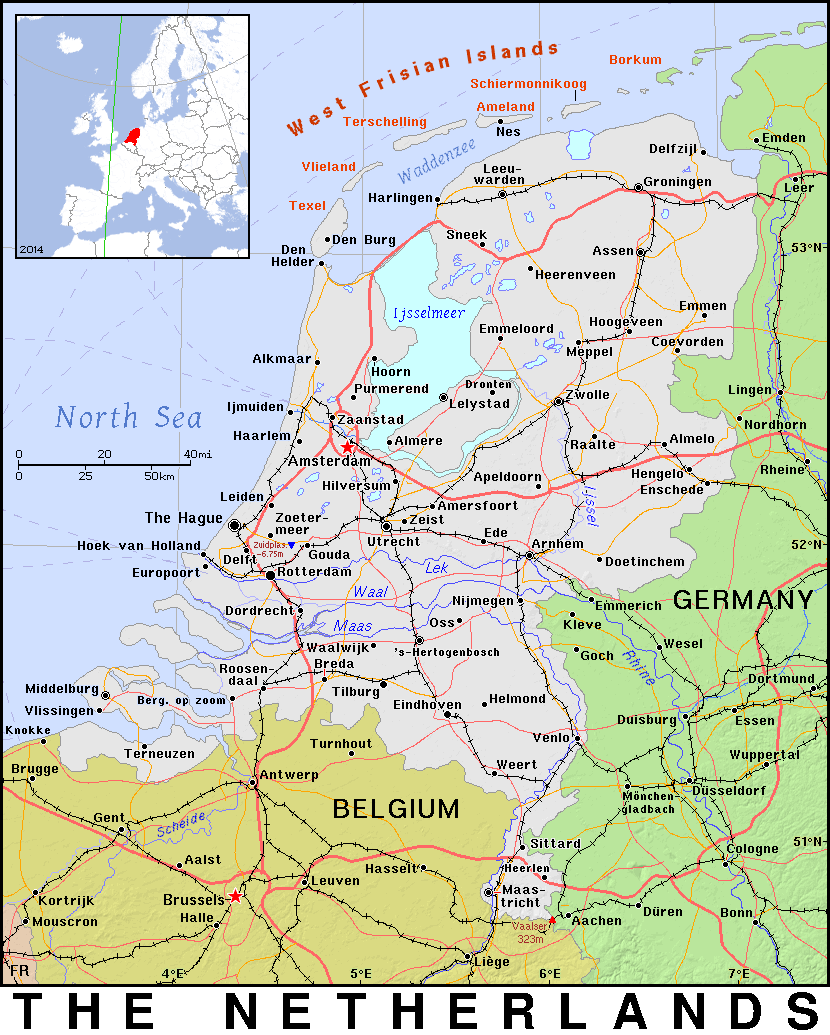 GIF
GIF  ZIP (TXT)