The coutry's cuisine is a rich tapestry of flavors and ingredients, offering a diverse range of dishes that can be broadly categorized into meat, fish, and coffee. The most popular drink in Greece is coffee, which the Greeks drink by the liter. They don’t like tea. Some sweets are often brought with drinks that are not included in the bill. By the way, they also always serve something free for dessert after dinner. |
1001  
|
Greece's New Year's custom involves parties with friends and relatives, where they exchange souvenirs with special wishes, adding charm to Greek culture. |
1001
|
The state is rich in historical monuments, with excavations visible even in cities. Areas marked with mysterious inscriptions highlight the country's historical significance. |
1001
|
There are only two megalopolises here: Thessaloniki and Athens. Small towns and villages occupy 90% of the territory. The houses are not high, usually no more than five floors. High-rise buildings are either offices or hotels. |
1001
|
Local inhabitants do not follow traffic rules well. This also applies to pedestrians. |
1001
|
The country ranks third in olive production in the world. The Greeks have grown olive trees since ancient times. Some of them, planted in the thirteenth century, still bear fruit. |
1001
|
It is usual for a Greek to be an hour late and to reschedule a meeting 10 minutes before it starts. |
1001
|
The first cookbook in history was written in the country. Many dishes in it were made from seafood. |
1001
|
The country are very proud of their cheese. Each region is famous for its type of cheese. The Greeks are also the nation that consumes the most cheese. |
1001
|
Thousands of words in any language in the world come from Greek. One of the languages most saturated with Greek words is English. |
1001
|
Discussions always accompany family and friendly gatherings in the country. The peninsula's penchant for debate has been ingrained in the inhabitants since Socrates, who claimed that truth is born in debates. |
1001
|
Fatty and spicy dishes predominate in local cuisine. Most national dishes are based on lamb or veal. |
1001
|
Feta is a traditional cheese made from goat and sheep milk. |
1001
|
Metaxa is the most famous local alcoholic drink. It is a unique mixture of Muscat wine and brandy. It is drunk neat or in cocktails. |
1001
|
Meze is a common Greek way characterized by the opportunity to try a wide scope of fish and meat dishes with various sauces. It is the prototype of the popular buffet. |
1001
|
Locals love fast food. Popular local gyros and souvlaki are similar to shawarma, contain a lot of meat, and are eaten with fried potatoes. Greek fast food is of the highest quality in Europe. |
1001
|
For local people, the sound ne means yes. The same meaning is a tilt of the head from the bottom up. Negation is expressed by the word ohi, or shaking the head from the bottom up. |
1001
|
Over 30 million foreigners visit Greece annually, and tourism is the leading sector of the local economics, accounting for approximately 16% of the country's GDP. |
1001
|
More than 250 days a year in Greece are clear. Such a natural advantage makes it possible to use solar panels everywhere to generate cheap electricity. |
1001
|
There is not a single nuclear power plant in the country. The country is implementing a green energy policy, and the primary energy source is thermal power plants based on natural gas (42%). |
1001
|
The country produces approximately 7% of the world's marble. |
1000
|
Greece supplies textiles, clothing, and agricultural products to European countries. |
1000
|
The distance from any point in Greece to the sea does not exceed 137 km. |
1000
|
Five seas wash the state's territory: the Aegean, Thracian, Ionian, Mediterranean, and Cretan. |
1000
|
The famous Butterfly Valley is located on the island of Rhodes, where many butterflies flock in the summer. This valley, with its unique ecosystem, has been a natural wonder for centuries, attracting visitors with its stunning beauty and diverse wildlife. The water in the local reservoirs is so clean that crabs can be seen at the bottom, adding to the valley's natural charm. |
1000
|
The local people typically wake up at 5-6 am and go to bed after 11 pm. To make up for the lack of night sleep, they observe a traditional siesta from two to four o'clock in the afternoon. During this time, many businesses and shops close, allowing people to rest and recharge before continuing with their day. |
1000
|
All budget professions are considered prestigious. They provide a stable income and a pension. Men very often work as teachers, doctors, and salespeople. |
1000
|
Locals eat 4 times a day. They start their meals with a light breakfast and a small snack. Usually, it is a bagel covered with sesame seeds. Greeks eat a hearty lunch with a change of courses during the siesta. Late in the evening, large Greek families gather for dinner. |
1000
|
According to various sources, Greece occupies the southeastern part of the Balkan Peninsula and has 1,400 to 6,000 islands. The largest is Crete, with an area of ??8,336 square kilometers. Greece's coastline is about 15,000 kilometers long. It is washed by several seas, including the Mediterranean, Ionian, and Aegean Seas. |
1000
|
The highest mountain in the country is the sacred Olympus. Its peak, Mytikas, rises 2,917 m above sea level. Ancient Greek myths tell us that the hill served as a refuge for the ancient Greek gods of the third and fourth generations, the so-called Olympians, headed by Zeus, the god of the sky, thunder and lightning, who knows the whole world. The deepest gorge in the world, Vikos, is located in Greece, going down 450-1,600 m. |
1000
|



 Share
Share

 PNG
PNG  PNG
PNG 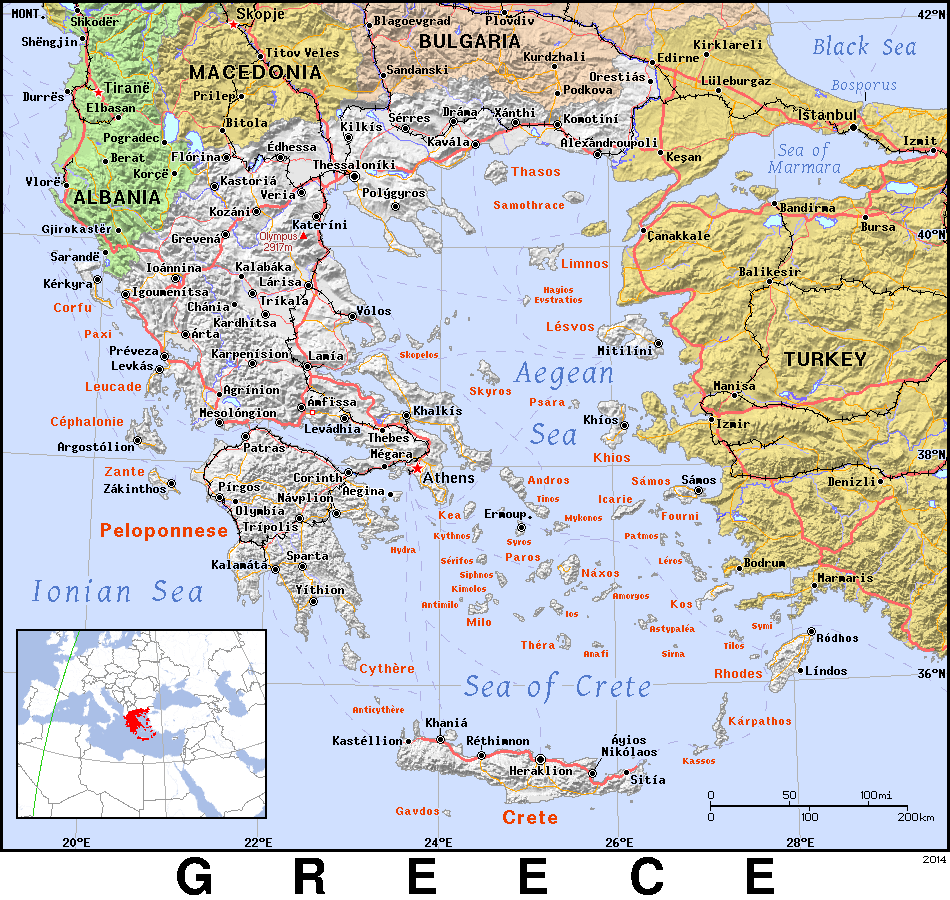 GIF
GIF  ZIP (TXT)