Even though Paris, the capital of France, is the most visited city in Europe and the world, Spain remains the most visited country in Europe. Spain, a kingdom with a king ruling nominally, is a land of unique cultural richness and diversity that never fails to intrigue and fascinate. |
1001  
|
The country, despite being a part of Europe, is just 9 kilometers away from Africa. This unique geographical location, coupled with its historical significance, is sure to enlighten and interest the readers. |
1001
|
The country, the birthplace of the pen, has made significant historical contributions that we should all appreciate and respect. |
1001
|
During the last ice age, only the territory of modern state escaped total glaciation from all of Europe, so when the ice retreated, the repopulation of Europe began from these lands. |
1001
|
The country began to lose its dominance in the seas after the famous Invincible Armada was scattered by a monstrous storm in 1588. On that black day, 133 Spanish ships went to the bottom. |
1001
|
Almost half of all olive oil in the world is produced here. However, most of the raw materials, the olives themselves, are exported from other countries. |
1001
|
There are about 280 sunny days in Spain every year. This country is rightfully considered sunny. |
1001
|
Spain ranks first among European countries in the number of bars, clubs, restaurants, and other entertainment and drinking establishments. |
1001
|
Spain is the most mountainous country in Europe after Switzerland: mountains occupy 90% of its territory. |
1001
|
The bull in the bullfight attacks the matador's cape not because it is irritated by the red color. Cows do not distinguish colors and react only to sudden movements. The red cape was chosen to make the bull's bloodlessness noticeable to the public. |
1001
|
The flu of 1918-1920 was called the Spanish flu because, unlike many others, the country did not have wartime censorship. Newspapers openly wrote about the spread of the epidemic, and residents of other countries had the impression that Spain was the country most affected by this flu. In fact, the epidemic began in the United States, and Spain was not even among the leaders in terms of the number of cases and deaths. |
1001
|
The smallest church in the world, Santa Isabel de Ungría in Colomares, is located in the country city of Malaga. This irregularly shaped building has an interior area of ??only 1.96 square meters. |
1001
|
In the carvings of the cathedral of the local city of Salamanca, built in the 12th century, you can find an astronaut in a spacesuit. There is no mysticism here: the figure was added in 1992 during restoration by one of the masters, who decided to place a figure of the conqueror of space at the entrance to the cathedral as a symbol of the 20th century. |
1001
|
The Grassi Clock Museum is open to visitors in Madrid. It presents the history of mechanical clocks, from the first exhibits of the 16th century with iron mechanisms to the imperial clocks of the 19th century. These clocks are not only important technical devices but also represent great artistic value; they are all alive and fully functional. |
1001
|
The expression blue blood was invented by Spanish aristocrats. The The local royal nobility always emphasized that they traced their ancestry back to the Visigoths and never mixed with the Moors, who came to Spain from Africa. Unlike the dark-skinned commoners, the pale skin of the upper class had blue veins, so they called themselves sangre azul, which means blue blood. |
1001
|
On the local island of Gomera, the locals speak a whistling language. The language owes its origin to the rocky terrain of the island and the small number of roads (that is why, instead of walking from one village to another, people preferred to whistle a message; the transmission range was 5-6 km). Speakers of this language press the tip of their tongue to their teeth and begin to whistle, simultaneously pronouncing words approximately as is done during a normal conversation. |
1001
|
Later, after being expelled from these lands, the Moors ruled the country for about eight centuries. |
1000
|
The Basque language, which is spoken in the north of Spain, is not related to any other language ??and is not part of any language group. During World War II, American radio operators used this rare language to transmit important messages so that no one could decipher them. |
1000
|
Football fans' cries of Ole-ole! at matches owe their origin to the country, where this word was shouted during bullfights or flamenco. It is believed that Ole is a modified word for Allah, which came to Spain during its occupation by Muslims in the 8th century. |
1000
|
The Spaniards were the first to taste tomatoes. In other European countries, tomatoes were long considered poisonous and used for decorative purposes: they were grown in pots on windowsills, cultivated in greenhouses, and planted along alleys. However, in Spain, these juicy berries were already consumed without any harm at the beginning of the seventeenth century. Nowadays, Spain holds an annual tomato festival, during which people throw ripe tomatoes at each other. |
1000
|
During a local feast, it is not customary to talk about wars, bullfights, and the period of Franco's rule. |
1000
|
Traditional Spanish cuisine does not include baked goods made from corn or wheat flour. Potato tortillas are considered very popular in Spain. |
1000
|
Here, meeting a married man under 30 is almost impossible. Spaniards start families at 35-40 years of age. Spanish women usually give birth to their first child at a ripe old age. It is customary to name children after their parents or close relatives. |
1000
|
Spain is the most mountainous country in Europe, and its capital, Madrid, is also the highest capital in Europe. |
1000
|
Despite various economic crises, Spain ranks 9th in the world by GDP. The Spanish banking system is considered one of the most stable systems in Europe. |
1000
|
The most popular sport is football. In 2010, the Spanish national football team became the world champion. |
1000
|
The country ranks third in the world in wine production. Wine is produced in all regions of the country. France and Italy take the first two places. |
1000
|
Surprisingly, each region of Spain is very different in terms of cuisine, customs, and language. |
1000
|
The usual dinner time in the country is 9-10 pm. |
1000
|
The local people are a very emotional nation. For this reason, they often stand very close and hold hands. So, do not be surprised by their behavior when communicating with a Spaniard. |
1000
|



 Share
Share

 PNG
PNG  PNG
PNG 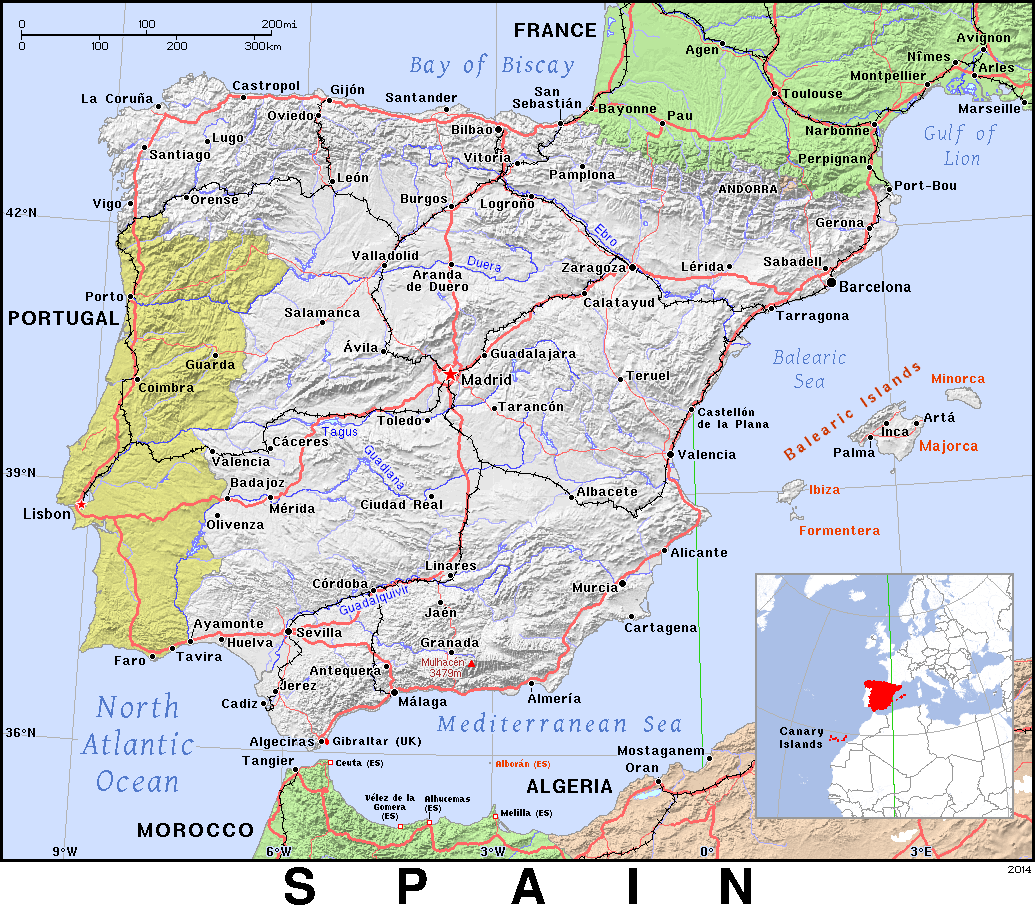 GIF
GIF  ZIP (TXT)