Local people drink about 130 liters of beer per person, just behind the Czechs at 160 liters. This custom for beer is very important to German culture. In Bavaria, enjoying a beer during work highlights the value of leisure and social connections. |
1001  
|
Bread holds a special place in the lands culture, with over 300 types of bread baked across the country. The reverence for this staple is so profound that there's even a museum dedicated to bread, a testament to its cultural and culinary significance. |
1001
|
Almost everyone, even supermarket workers, rests on Sundays, so you need to stock up on provisions in advance. |
1001
|
German business letters, even complaints and fines, end with Mit freundlichen grüßen - With friendly greetings. |
1001
|
In Germany, working in the civil service is profitable because government employees do not have to pay taxes and it is almost impossible to fire them. |
1001
|
The capital is Berlin, the largest city in the country and the second most populous city in the EU after London. |
1001
|
The German national anthem was written in 1841. |
1001
|
The length of the meter in Berlin is 151.7 km (173 stations). Built in 1902. |
1001
|
West and East Germany united in 1990. |
1001
|
Germans invented the New Year tree. |
1001
|
Unlimited speed is allowed on 70% of the motorway. |
1001
|
The first book was printed in Germany. |
1001
|
The largest festival in the world - Oktoberfest takes place in Munich. |
1001
|
Insulin, gasoline, and calculator were invented in Germany. |
1001
|
The Brothers Grimm created the first German dictionary in 1838. |
1001
|
The dialects of the German language are so diverse that they reflect the rich cultural and historical tapestry of the country. In the north of Germany, for instance, programs are shown in which people from the southern part of the country speak, and subtitles are added to the program to bridge the linguistic gap. This diversity is a testament to the regional pride and identity that Germans hold dear. |
1000
|
The country is ahead of the rest of the world: it was the first brewery, the first savings bank, and the country to switch to daylight saving time. |
1000
|
The tallest building in the country and the fourth in the world - Berlin TV Tower - 368.03 m. |
1000
|
Ferdinand Porsche created the Volkswagen cars in 1937 for the people (Volkswagen - Volk - people, Wagen - car). |
1000
|
There are significant regional economic differences in Germany, with the western and southern regions being more developed than the eastern regions. This imbalance is a legacy of the historical division between East and West Germany, highlighted by the Berlin Wall. Even after reunification in 1990, economic gaps remain. |
1000
|
Germany was defeated in both World War I and World War II. In World War I (1914-1918), Germany and the Central Powers faced significant consequences after their defeat. In World War II (1939-1945), Nazi Germany, led by Adolf Hitler, was defeated by the Allies. It leaded to the division of Germany into East and West. |
1000
|
The country is famous for its autobahns, a high-speed highway network with no general speed limits. Initially built in the 1930s, these roads are essential to the country's transportation, economics, and efficient travel. |
1000
|
Germany is home to over 20,000 castles, some well preserved, while others are in ruins. Among the most famous: Neuschwanstein Castle in the Bavarian Alps, Burg Eltz above the Mosel River, Heidelberg Castle, Wartburg Castle near Eisenach, Oktoberfest - the largest beer festival. |
1000
|
The world's largest beer festival takes place annually in Munich from late September to early October. The festival attracts millions of visitors who enjoy traditional Bavarian beer, delicious food, and live music. |
1000
|
The country boasts over 1,200 different types of sausage, or “Wurst.” They vary in flavor, texture, size, and regional preparation methods. Popular types include Bratwurst, Weisswurst, Thüringer Rostbratwurst, and Currywurst. |
1000
|
The Protestant Reformation began in Germany with Martin Luther's publication in 1517. This movement challenged the Catholic Church and led to new Protestant denominations and significant European social, political, and cultural changes. |
1000
|
In medieval Germany, Magdeburg introduced Magdeburg Law in the 13th century. This legal code granted citizens all sorts of rights and privileges, forming the basis for city government. By the 15th century, more than 600 cities had adopted the code, which became the template for municipal government in Germany and other European regions influenced by German settlement. |
1000
|
The Hamburger gets its name from the German city of Hamburg. The dish comes from a local recipe for minced beef mixed with onions and spices. German immigrants brought this culinary tradition to the United States in the 19th century, where it evolved into the modern hamburger, a popular and iconic American dish. |
1000
|
The first book printed using moving-type technology was made in Germany. Johannes Gutenberg, a German inventor, created a printing press with moving metal type around 1440. His Bible, completed around 1455 in Mainz, was a milestone in the history of printing by making information more accessible. The Gutenberg Bible is considered one of the first major books published with moving type and is a key moment in the development of publishing. |
1000
|
Cologne Cathedral in Germany is a stunning Gothic masterpiece that took 632 years to complete, beginning in 1248 and finishing in 1880. Despite facing financial, political challenges, and the plague, it showcases exceptional German craftsmanship and remains one of Europe’s largest cathedrals, attracting millions of visitors each year. |
1000
|



 Share
Share

 PNG
PNG  PNG
PNG 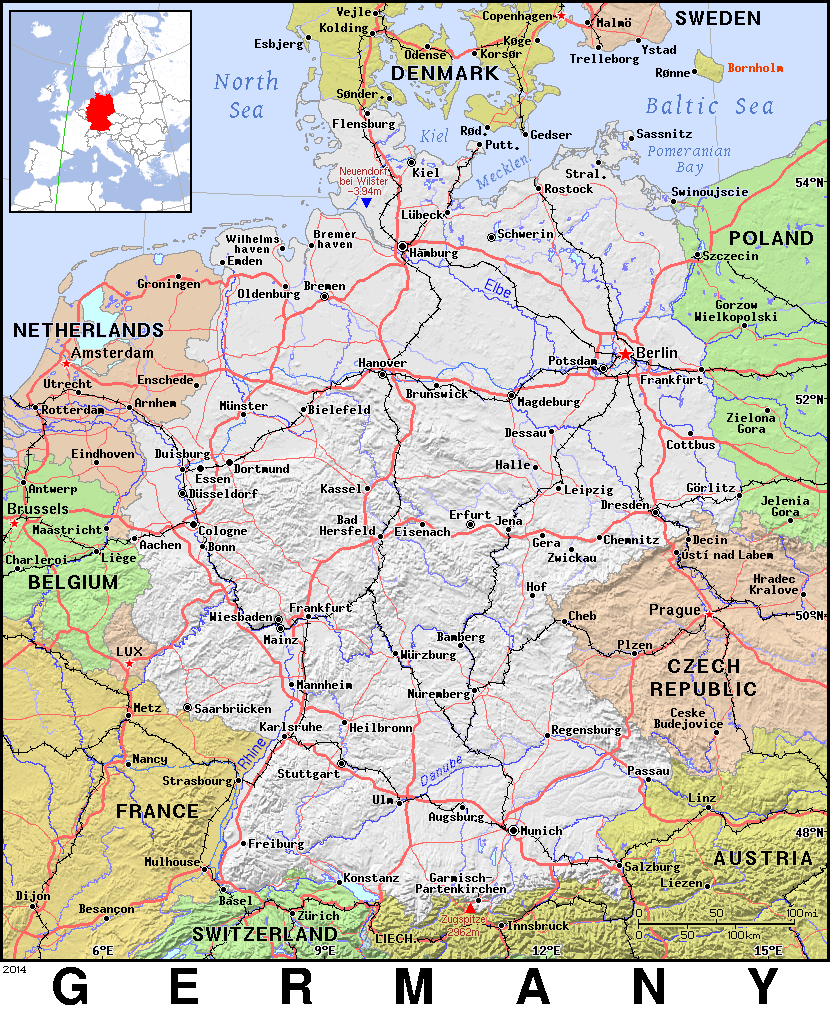 GIF
GIF  ZIP (TXT)