Tango. This passionate dance originated here. Two hundred years ago, it was considered too obscene. Couples danced tango only on closed stages. At the end of the 19th century, young, rich Argentines brought their fiery dance to the Old World. |
1001  
|
The Argentinosaurus is one of the largest dinosaurs ever known in the world. It is undoubtedly one of the largest animals to have ever walked the Earth. |
1001
|
The 9 de Julio Avenue is a central road 110 meters wide, divided into 16 lanes. |
1001
|
With an altitude of 6960.8 m above sea level, Aconcagua is the highest peak in the southern and western hemispheres, the highest on Earth after the Himalaya system (Asia) and therefore the highest peak in the Americas. |
1001
|
Argentina is a significant and very diverse country, but it is very far away from us territorially. You can see everything here, from wild jungles in the north to practically eternal winter in the south. |
1001
|
The country's name comes from the Latin word «Argentum,» which translates to «silver.» The first European settlers thought that Argentina was rich in silver, but this rumor was not confirmed. |
1001
|
The country's inhabitants are mostly white and look like Europeans. This is due to its history: when the Spaniards arrived here in the 16th century, the native Indians were not a large nation. The population was formed from European immigrants and the descendants of Europeans from marriages with Indians and blacks. |
1000
|
Argentines speak Spanish with a distinctive accent influenced by neighboring Brazil's Portuguese. |
1000
|
Football is vital to the country culture, with students getting extra days off during major competitions to watch matches. Diego Maradona and Lionel Messi are two internationally renowned players, and the national team regularly excels in international events. |
1000
|
The capital of the state was founded in 1536 by the Spanish conquistador Pedro de Mendoza. Its name translates as good winds. And this is true: a fresh wind constantly blows in the city, but there is practically no frost. |
1000
|
The 82-meter-high system of giant waterfalls is located almost on the border with Brazil, 7 kilometers from the airport and 18 kilometers from the city of Puerto Iguazu. |
1000
|
At the southern tip of the country is Tierra del Fuego, where the continent ends, and the exit to Antarctica opens. In the Beagle Channel is the southernmost city in the world—Ushuaia. Polar explorers set off from here to explore Antarctica. The city's museums reflect its history. |
1000
|
Patagonia is a wild land with many national parks, which have made the country famous worldwide. The most famous national park in Patagonia is Los Glaciares. |
1000
|
The Perito Moreno Glacier is one of the most visited tourist sites in Argentina and one of the three Patagonian glaciers that continue to glacierize. |
1000
|
The Mar Chiquita Lagoon or Mar de Ansenuza is a huge saltwater lagoon located in the northeast of the province of Cordoba. Its surface varies depending on the season, but it is estimated that on average it may be around 8,000 km². |
1000
|
In 2011, Iguazu Falls was chosen as one of the New 7 Wonders of the World. |
1000
|
If you are a tourist who loves unusual and quiet places, go to the Recoleta Cemetery (Cementerio de la Recoleta) - it is located in the center of Buenos Aires, in the prestigious district of the same name. This, by the way, is one of the famous cemeteries in the world, it is even recognized as a national museum. As such, you will not see graves here: this place will rather remind you of an open-air sculpture exhibition. |
1000
|
Argentina's population is a vibrant tapestry of diversity. Almost half (about 40%) of the state's population is of Italian origin, and most of the rest have German roots, adding a unique cultural blend to the country. |
1000
|
The land is home to many species of animals that are not found anywhere else in the world. |
1000
|
Argentina was one of the first countries to broadcast radio. The first radio broadcast was carried out on August 27, 1920. Her audience consisted of 20 people. |
1000
|
Argentina is among the countries with the highest average life expectancy. On average, men live 74 years, and women 80 years, which is ~77 years on average. |
1000
|
The state is divided into 23 provinces and an autonomous city - Buenos Aires. Each has its constitution, but the federal system governs it. |
1000
|
Argentina is home to notable scientists, including three Nobel laureates. The country has made significant contributions to science, such as dactyloscopy and the ballpoint pen. Additionally, its cuisine is famous worldwide, earning Argentina the title of the breadbasket of the world for its rich food production. |
1000
|
In 2001, 5 presidents changed in Argentina in 10 days. |
1000
|
Since the beginning of 1970, due to inflation, Argentina has removed 13 zeros from its currency. |
1000
|
Local cuisine is famous all over the world; Argentina is called the breadbasket of the world for no reason - this country produces so much food that it would be enough for the whole world. |
1000
|
Argentina is the first Latin American country to fly on jet aircraft. |
1000
|
The country's favorite drink is mate, a tonic Paraguayan tea, which is recommended to be drunk through a special tube with a sieve—bombizhyu. If an Argentinian offers someone a date, it means that he likes this person. |
1000
|
Argentina, a prominent South American country, has a brief history but a rich culture. Its cosmopolitan capital showcases the central Plaza de Mayo and impressive buildings like the Casa Rosada, the presidential palace, reflecting the nation's vibrant heritage. |
1000
|
The state's uranium reserves enable important nuclear energy research. |
1000
|



 Share
Share

 PNG
PNG  PNG
PNG 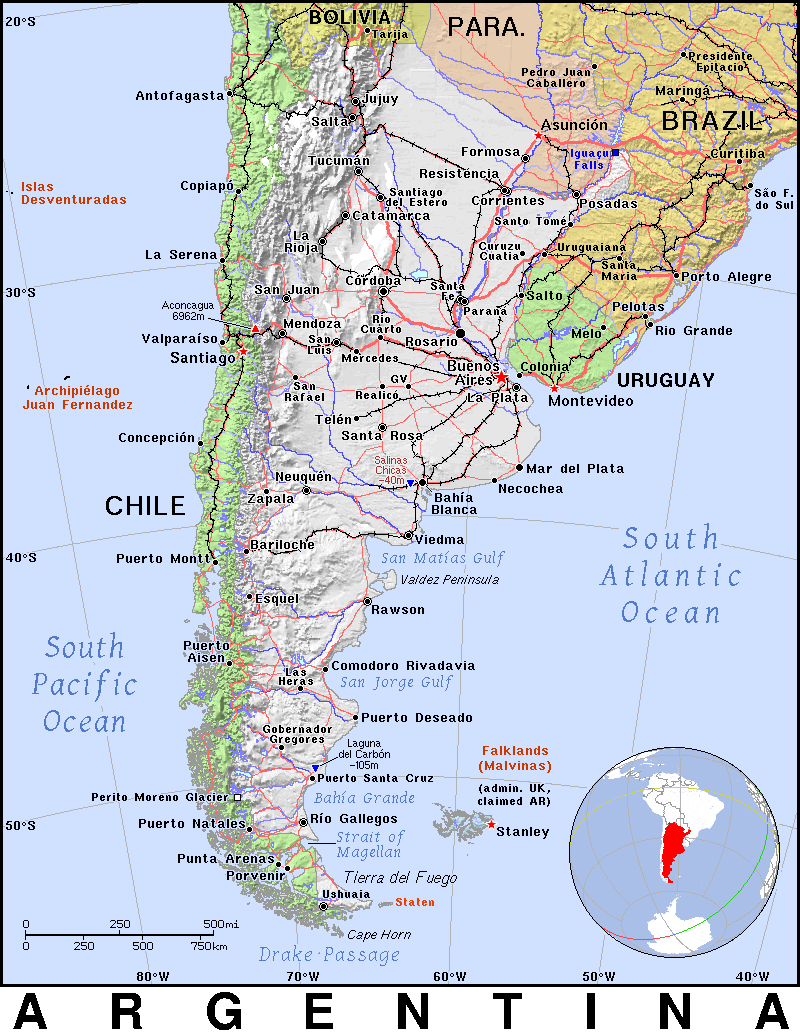 GIF
GIF  ZIP (TXT)