The first conquest of Mexico occurred in 1519. However, the Spanish conquistadors did not know that their military prowess did not contribute to their victory. They unwittingly brought with them a smallpox epidemic, a disease to which the native Mexicans had no immunity. This epidemic, along with other European diseases, is estimated to have killed about three million native Mexicans, a number that some historians believe to be much higher. The devastating impact of these diseases on the native population is a tragic chapter in Mexico's history. |
1001  
|
The country is home to the oldest university in North America. It was called the Royal and Pontifical University of Mexico and was founded in 1551 by King Charles V of Spain. It functioned until 1865. The National Autonomous University of Mexico, founded in 1910, traces its roots to this university, but there is no objective evidence of continuity. |
1001
|
Mexico is one of the six cradles of civilization. Human civilization is believed to have begun in Mexico at least 8,000 BC. The Olmec, Toltec, Teotihuacan, Zapotec, Mayan, and Aztec empires arose here, putting Mexico in the same league as other so-called cradles of civilization – ancient India, Egypt, China, Peru, and Mesopotamia. This rich historical significance of Mexico is something to be respected and appreciated. |
1001
|
Mexico City was built on the site of Tenochtitlan. Tenochtitlan, an ancient city of about 150,000 people on an island in the middle of a lake, seemed like a good place for the Mexican capital. The colonists began filling in the lake, cultivating the land, and building what is now Mexico City. |
1001
|
Nobody Knows What the Word Mexico Means. No, really – there is no consensus on the etymology. Some say it means The Place Where the God of War Lives (the name of the God of war is Mexi); others – In the Navel of the Moon. But, frankly, no one knows the truth. |
1001
|
The Mexican silver peso was the first global currency, minted in vast quantities from Mexico's silver during colonial times. These coins, known as Spanish dollars or pieces of eight, were used in Spain, the Caribbean, and Southeast Asia, and were worth eight reales, Mexico's currency. |
1001
|
Mexico is home to a rare species of rabbit called the Volcano Rabbit. Before you imagine a hybrid of a rabbit and a lava Pokemon, this is not it. The Volcano Rabbit (also known as the Teporingo or Zacatuche) is a super cute rabbit living in Mexico's volcanic mountains. It is critically endangered and is the second smallest rabbit in the world after the dwarf rabbit. |
1001
|
This country is home to at least a tenth of the world's biodiversity, another interesting fact about Mexico. That's about (or more than) 200,000 species in Mexico's diverse ecosystems. |
1001
|
Most of the United States was once Mexico. After the Mexican-American War (1846-1849), what is known as the Mexican Cession took place. This means that most of Mexico became US territory. We're talking California, Nevada, Utah, most of Arizona, about a quarter of Colorado, half of New Mexico, and even a little of Wyoming. Even Texas was part of Mexico. This gives you an idea of ??how big Mexico was. Texas declared its Independence after the 1836 revolution and became a US state in 1845. |
1001
|
The largest bullring in the world is in Mexico. Mexico has about 225 bullrings, all thanks to centuries of Spanish colonial rule. The bullfighting season runs from November to April. Plaza Mexico, the largest, wastest bullring globally, is located in Mexico City (capacity 41,262). |
1001
|
Mexico once had a war called the Pastry War. It is also known by the official, much more reasonable name of the Franco-Mexican War. The battle lasted three months, from 1838 to 1839, and was about French imports and exports. French goods were heavily taxed, and the Mexicans were not about to put up with it. |
1001
|
Frida Kahlo is the most famous and interesting Mexican artist, known for her colorful and sensual self-portraits. She was also the partner of fellow artist Diego Rivera. Her La Casa Azul (The Blue House), in a charming suburb of Mexico City, which is now a museum honoring her remarkable artistry and life. |
1001
|
The first printing press in the Americas was built in Mexico City |
1001
|
In 1539, King Charles V of Spain (who founded the first university in Mexico) allowed Juan Zumárraga. The Archbishop of Mexico City brought a printing press from Europe. You can still see it in the Casa de la Primer Imprenta de América, where it first appeared and has remained for many years. |
1001
|
Mexico City is sinking. Building a city on land in the middle of a lake isn't the best idea. As the demand for water increases, authorities are pumping more and more water out of the lake, further destabilizing the soil. The result? The Mexican capital is sinking 15 cm a year, which is severe. |
1001
|
Chichen Itza, one of the Seven Wonders of the World, was built between the 8th and 10th centuries AD. It attracts over 2.6 million tourists each year. Interestingly, the land beneath this ancient site remained privately owned until 2010 when it was acquired by the Yucatan government. |
1001
|
Mexico City Has a Lot of Taxis. Mexico City has over 100,000 taxis, making it the largest taxi fleet of any city in the world. This army of cars serves a population of 9,000,000 people. Even if you think of a city like New York City as a place with taxis, only 14,000 taxis are plying the streets of the Big Apple. |
1001
|
The word Mexico means the navel of the Moon, from the Aztec Nahuatl words Metztli Moon and exactly navel. The inhabitants of these lands pronounced the word Mexico. |
1001
|
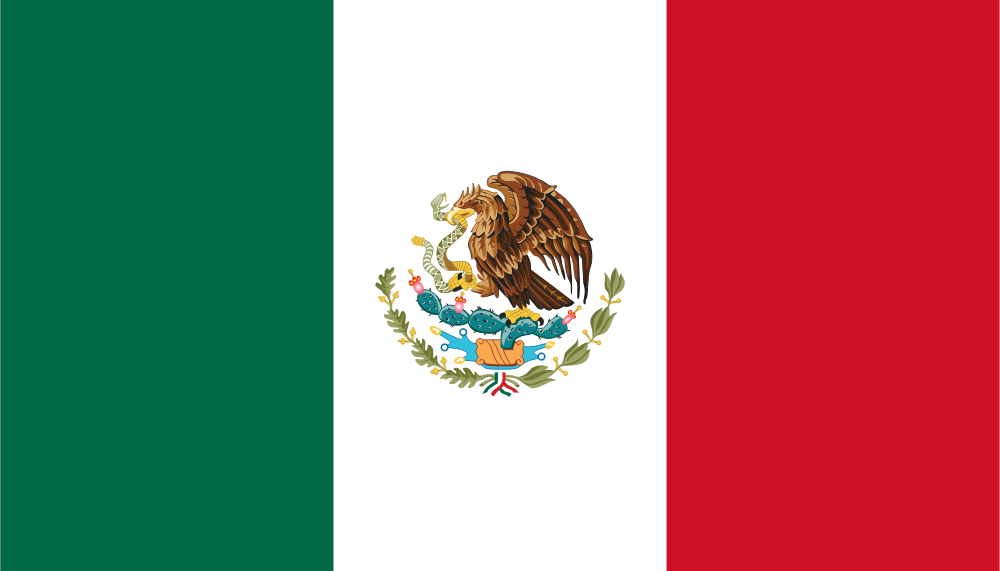
In the middle, on the white stripe, there is a golden eagle pecking a snake, a symbolic sign that the Aztecs were looking for to find the city of Tenochtitlan, the country's ancient capital. |
1000
|
Isn't it amazing that the meteorite that led to the dinosaurs' extinction 65 million years ago struck the Chicxulub region of the Yucatán Peninsula? Nature has such captivating stories to explore!The impact formed a crater 180 km in diameter, now located at a depth of 600 m. It was discovered in 1981 by workers of the Pemex company, who noticed a sharp change in the soil density at this depth. |
1000
|
One of the most important pre-Hispanic civilizations in the country was the Olmecs, who lived in these lands from the 1400s BC to the 300s AD. The Olmecs are known mainly for their huge stone heads, which can be inspected in museums in the country. |
1000
|
When the Spanish conquistador Hernan Cortes arrived on the land shores, he was received as a god and presented with the sacred drink cocoa. |
1000
|
The part of the land known as the Yucatan Peninsula has been described since the time of the conquest. A Spaniard asked an Indian what this place was called and heard the Yucatan answer. But he had no idea that the native answered him: I do not understand you. |
1000
|
More than 200,000 different species can be found on its territory, which, according to various sources, is 10 to 12% of the world's living beings. Five types of climate and 9 out of 11 types of ecosystems are also represented here. |
1000
|
The land has the largest number of reptiles, with 707 species living on its territory. It also ranks second in mammals (491 species), fourth in amphibians (282 species), and fifth in plants (26,000 species). |
1000
|
Just over 77% of the cactus species growing in Mexico are endemic, meaning they cannot be found anywhere else. |
1000
|
Poinsettia, or Euphorbia pulcherrima, is considered the Christmas flower in Mexico. It comes from here and is named after the first US ambassador to Mexico, Joel Roberts Poinsett, in the 19th century. As a doctor, he was interested in the plant's medicinal properties. |
1000
|
The Xoloitzcuintli, or Xolo, is a breed of dog known as the Mexican Hairless Dog. Its homeland is Mexico, and the breed is over three thousand years old. The ancient inhabitants of Mexico highly valued the meat of these animals, considering them clean. This unique tradition adds to the cultural richness of Mexico and is sure to intrigue and fascinate the reader. |
1000
|
Mexico's second-longest coral reef is located 200 m from the island of Cozumel This is in the state of Quintana Roo. This natural wonder is sure to inspire and amaze the reader, showcasing the diverse beauty of Mexico. |
1000
|
Mexico City, the capital of Mexico, is located in a basin surrounded by volcanoes, notably Popocatepetl and Iztaccihuatl. |
1000
|



 Share
Share

 PNG
PNG  PNG
PNG 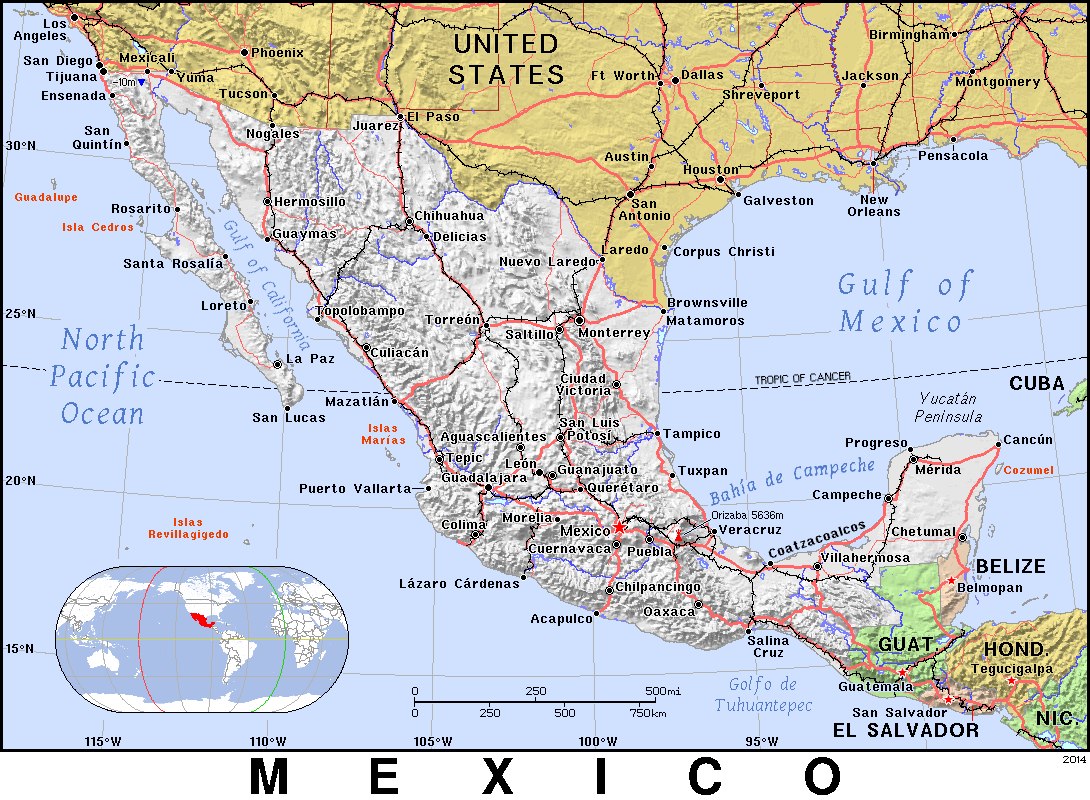 GIF
GIF  ZIP (TXT)